

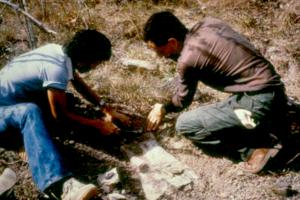
The first discovery of dinosaur fossils in Thailand was made in 1976 when the Department of Mineral Resources (Thailand) sent out a geological team to conduct a uranium survey in Phu Wiang District, Khon Kaen Province. The team discovered a large piece of fossilised bone at Pratu Ti Ma on the West Phu Wiang site. French paleobiologists verified that these fossilised remains were fragments of a prehistoric Sauropod dinosaur, which is a large herbivorous dinosaur first found in Thailand. This dis

Dinosaurs evolved from reptiles. They increased in number and species and spread out to the entire Earth during the Mesozoic Era, the geological time frame that spanned 251 to 65 million years ago. The Mesozoic Era was subdivided into three periods: Triassic, Jurassic and Cretaceous.
During the Triassic period (251-200 million years ago), there was only a single supercontinent, called Pangaea, and surrounded by a vast ocean. The middle of the supercontinent was a massive hot desert. Dominant
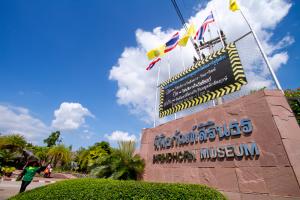

Dinosaur is an amazing terrestrial creature with an immense body size and physical appearance that is reminiscent of the science-fiction fantasy movies. They dominated the earth for as long as 160 million years and was developed and diverged into many different species spreading throughout the earth until the mysterious extinction event that occured 65 million years ago. Even then, they are still able to captivate our attention that no other primitive lives can.
Let’s go visit the dinosaurs t

The exhibition zone 1 of the Sirindhorn Museum is put together under the concept of "Universe and the Earth”. In addition to the presentation on the birth of the universe, we will also learn about how our planet came into being.
The large globe mounted on the wall displays the earth structure with several layers of earth crusts. Visitors can move those metal earth crusts back and forth in order to understand how our earth was formed in layers and has been in a constant movement.
The to

Dinosaurs did not suddenly appear on earth. In fact, they were a part of a lengthy and continuous biological evolution.
You can learn about prehistorical animals from the story of the Paleozoic Era in the exhibition zone 3
The Paleozoic Era was a time before the appearance of dinosours, spanning 291 million years and being subdivided into 6 geological periods, chronologically shown as follows:
The Cambrian Period (542-488 million years ago): In the beginning of this period, no terrestrial
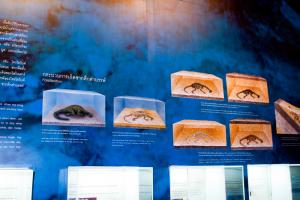
Even though dinosaurs have been extinct from the Earth for millions of years, we can still learn about their different species from the fossilised remains left in the excavation sites.
When a dinosaur died, most of its remains were decayed completely. By a small chance, however, given the right location and the right timing, some of the remains would be preserved as fossils.
For example, dinosaurs that died in a river-edge beach were rapidly buried under sand or mud sediments; thus, were pro
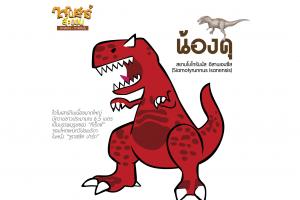
Nong Yong, Nong Priao, Nong Khae, and Nong Du are the 4 mascots that were created to promote the TAT’s “Dinosaur Sa-On” tourism campaign. Dinosaur Sa-On was a 260-km route that started from Phu Wiang, Khon Kaen province, and continued through Phu Kum Khao and Phu Faek, Kalasin Province. The route was considered Thailand’s richest and most complete source of dinosaur-themed expedition.
Nopharat Kokwan, Director of the TAT Khon Kaen office, discussed the 4 mascots’ names that they originated
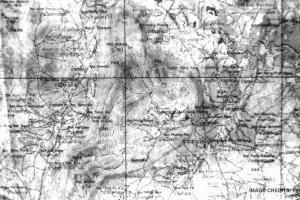
Phu Wiang is a stomach-shaped mountain range that stretches from the North to the South. In the middle of the eastern side of Phu Wiang is an inland basin surrounded by a ring of mountains with an elevated flat-top called a tableland.
The geology of the Phu Wiang Mountains is classified as non-marine Mesozoic rocks in the Korat Group, of which the strata was initiated in the time of the Jurassic Era. Other groups of the same geological time are Nam Phong, Phu Kradueng, Phra Wihan, Sao Khua, Ph
- ‹ previous
- 8 of 11
- next ›