

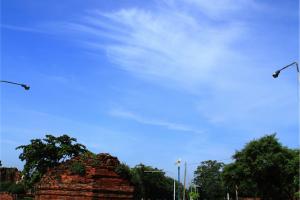
King Boromarachathirat II (Chao Sam Phraya) ordered the construction of these two well-known chedis (stupas) in 1424 as monuments for his brothers Chao Ai Phraya and Chao Yi Phraya. Upon the death of their father, King Nakharintharathirat, two of the eldest sons brought troops into the city to contest the throne. They both met at the Pa Than Bridge in elephant-mounted combat, slaying each other.
Chao Sam Phraya, who later came from Chai Nat, assumed the throne as the rightful successor an
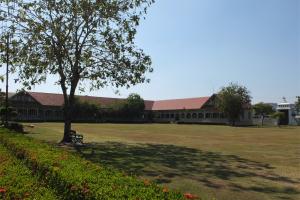
Chandrakasem Palace is thought to have been built around 1577 during the reign of King Phra Maha Thammaracha and was used as the residence of King Naresuan the Great when travelling from Phitsanulok to visit his father in Ayutthaya. After the position of “Wang Na” was given to Krom Phra Ratchawang Bowon Sathan Mongkhon it was used thereafter as the residence of the successor to the throne (Wang Na). It was later used by King Ekathotsarot, Chaofa Suthat, King Narai the Great, Khun Luang Sorasa
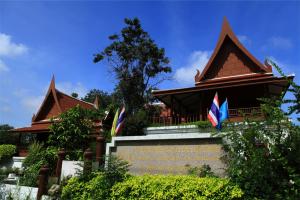
The Tourism Authority of Thailand (TAT) has converted the Old City Hall in Phra Nakhon Si Ayutthaya into a modern day Tourist Information Centre. It holds current exhibitions that give an overview of the city and is the ideal stop for a quick understanding of the splendid former capital of Thailand.
It was originally built in 1941 under the administration of Luang Borihan Chonnabot (San) with the aid of Mr. Pridi Banomyong, Finance Minister under the government of Field Marshal Plaek Pibul
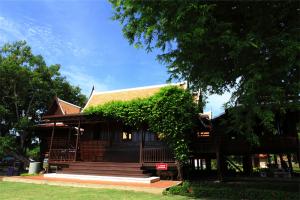
After visiting the ancient palace and paying respect to the Buddha image at Wat Mongkhon Bophit, another nearby site that should not be missed is the Khum Khun Phaen. It is a good historical example of the Central Thai-style houses for wealthy families that are rarely found today. The architecture reflects local knowledge in building a home that suited the environment and weather with a focus on functionality.
The Khum Khun Phaen comprises of 5 houses. The largest house to the West is call
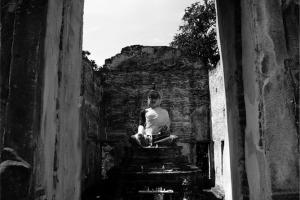

Most of the magnificent architecture and sculptures of the Ayutthaya period were crafted for worship and devoted to Buddhism. Their beauty represents beliefs and technical masteries that were accumulated over many generations; a collection adapted from a variety of arts to form its own unique style.
A prominent feature of the mid-Ayutthaya period is the bell-shaped chedi; such as, those found at Wat Yai Chai Mongkhon, Wat Phra Si Sanphet and many more. Ubosots (ordination halls) from this
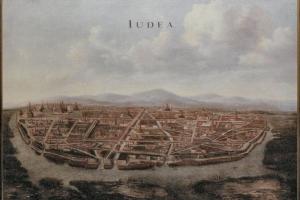
The ruins and historic sites of many temples within the vicinity of the historical city of Ayutthaya, which has since been listed as a World Heritage Site by UNESCO, cover the whole of Ko Mueang and its outlying areas. The greatness of this historical city owed much to the culmination of wisdom that had been passed down over the centuries, so that it was unique for the city to hand down its glory from generation to generation. Furthermore, it is a city of culture where people live to the present
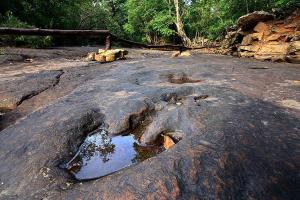
During late 1996, two local girls - 10-year-old Kalayamas Singhnaklong and 11-year-old Patcharee Waisane, found a set of dinosaur footprints at the site of Phlan Hin, also known as Wang Khruea Chan at the hillfoot of Phu Faek in King Amphoe Na Khu in Kalasin province. Later on, the dinosaur exploration team from the Department of Mineral Resources discovered 21 footprints along the 6 pathways walking in different directions. From those, there are three obvious walkways as indicated as follows:
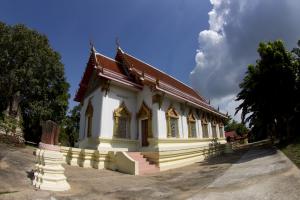
Wat Ratchapraditsathan was an ancient temple built in the Pre-Ayothaya period. Wat Ratchapraditsathan lies at the month of Klong Pratu Khao Plueak, on the west bank of U-thong Road in the City Island. Even though this temple was mentioned many times in the Royal Chronicles of Ayutthaya, there was no evidence stating who built the temple and in which reign. However, from the name of the temple, it can be assumed that one of the kings had ordered to build this temple and still kept its importance
- ‹ previous
- 6 of 11
- next ›