

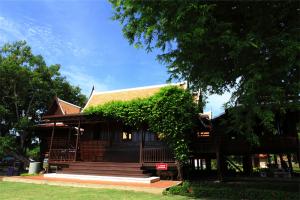
After visiting the ancient palace and paying respect to the Buddha image at Wat Mongkhon Bophit, another nearby site that should not be missed is the Khum Khun Phaen. It is a good historical example of the Central Thai-style houses for wealthy families that are rarely found today. The architecture reflects local knowledge in building a home that suited the environment and weather with a focus on functionality.
The Khum Khun Phaen comprises of 5 houses. The largest house to the West is call
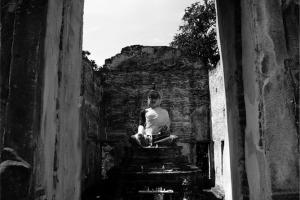

Most of the magnificent architecture and sculptures of the Ayutthaya period were crafted for worship and devoted to Buddhism. Their beauty represents beliefs and technical masteries that were accumulated over many generations; a collection adapted from a variety of arts to form its own unique style.
A prominent feature of the mid-Ayutthaya period is the bell-shaped chedi; such as, those found at Wat Yai Chai Mongkhon, Wat Phra Si Sanphet and many more. Ubosots (ordination halls) from this
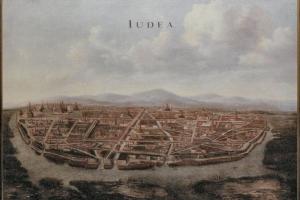
The ruins and historic sites of many temples within the vicinity of the historical city of Ayutthaya, which has since been listed as a World Heritage Site by UNESCO, cover the whole of Ko Mueang and its outlying areas. The greatness of this historical city owed much to the culmination of wisdom that had been passed down over the centuries, so that it was unique for the city to hand down its glory from generation to generation. Furthermore, it is a city of culture where people live to the present
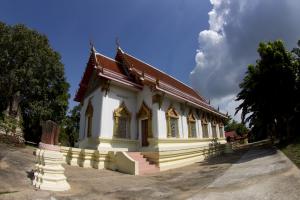
Wat Ratchapraditsathan was an ancient temple built in the Pre-Ayothaya period. Wat Ratchapraditsathan lies at the month of Klong Pratu Khao Plueak, on the west bank of U-thong Road in the City Island. Even though this temple was mentioned many times in the Royal Chronicles of Ayutthaya, there was no evidence stating who built the temple and in which reign. However, from the name of the temple, it can be assumed that one of the kings had ordered to build this temple and still kept its importance
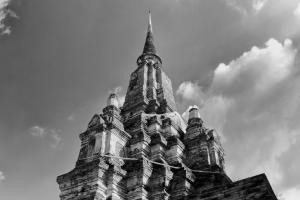
This ancient temple was constructed in the early Ayutthaya period and its original name Wat Yanusen. It is located on the north side of the City Island close to Klong Maha Thera Maichae. This area was the residence of the Mon people. There is no evidence stating who built the temple. A legend stated the royal storage for robes and accessories used for the royal elephant daily routines close to this temple. The water passage was in front of Wat Yarnnasen. From the north side of the temple, the
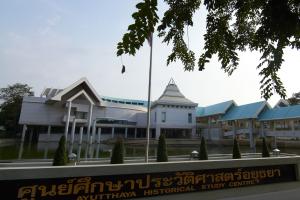
The Ayutthaya Historical Study Centre (AHSC) was established in 1986 by the Japanese grant aid projects to honour the Auspicious Occasion of His Majesty the King’s 60th Birthday Anniversary and also to commemorate the occasion of the 100th anniversary of the relationship between Japan and Thailand. The AHSC is a national research institute devoted to the study of Ayutthaya’s history. There are 2 exhibition buildings: one is in this building and the annex building was recently established within
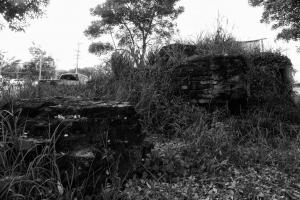
The crossing point between Si Sanphet Road and Pa Thone Road of the City Island is called “Talaengkaeng”, the busiest quarter in the city centre. From the old records written by a foreign visitor during that period, the area from the city entrance to the Talaengkaeng quarter was the most popular and most crowded neighbourhood. Groceries and the city markets that were opened from morning to evening included Talat Na Khouk and Talat Na San Phra Kan. In order to spread the word out quickly to as m
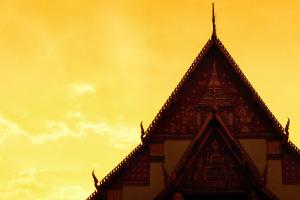
Vihara Mongkol Bopit is located on the south side of Wat Phra Sri Sanphet. Each day visitors are crowded inside to pay respects to Phra Mongkol Bopit, the large bronze Buddha covered with gold leaves. Once walking into the main Vihara, the fullfilling sensation received from looking up at Phra Mongkol Bopit is the peacefulness from the Buddha’s gentle face.
Phra Mongkol Bopit is in Subduing Mara posture measuring 12.45 meters in height, and considering one of the largest bronze Buddha statues
- ‹ previous
- 4 of 6
- next ›